

-
1 equipment, tools and appliances and fastenings for the manufacture and installation of ventilation and plumbing units and articles
Универсальный англо-русский словарь > equipment, tools and appliances and fastenings for the manufacture and installation of ventilation and plumbing units and articles
-
2 WEEE (Waste Electrical and Electronic Equipment) directive 2002/96/EC
- директива 2002/96/EC по отходам электрического и электронного оборудования (WEEE)
директива 2002/96/EC по отходам электрического и электронного оборудования (WEEE)
-Параллельные тексты EN-RU
WEEE (Waste Electrical and Electronic Equipment) directive 2002/96/EC
The main purpose of the WEEE directive is the prevention of Waste Electrical and Electronic Equipment (WEEE) and its re-use, recycling and any other form of recovery so as to reduce the amount of waste for disposal. This directive applies to products sold in the European Union after 13/08/2005.
The WEEE directive concerns electrical and electronic equipment with an operating voltage of less than 1000 V and which is included in the following 10 equipment categories listed below:
- Large household appliances
- Small household appliances
- IT and telecommunications equipment
- Consumer equipment
- Lighting equipment
- Electrical and electronic tools
- Toys
- Medical equipment
- Control and monitoring equipment
- Automatic dispensers
[Legrand]Директива 2002/96/EC по отходам электрического и электронного оборудования (WEEE)
Основная задача директивы WEEE – предотвращение образования отходов электрического и электронного оборудования (WEEE) и обеспечение повторного использования, переработки и других форм восстановления таких отходов с целью уменьшения объема утилизируемых отходов. Директива распространяется на товары, продаваемые в странах Европейского Союза после 13 августа 2005 года. Директива WEEE затрагивает электрическое и электронное оборудование на номинальное напряжением до 1000 В, относящееся к одной из следующих 10 категорий:
- крупная бытовая техника;
- мелкая бытовая техника;
- сетевое и телекоммуникационное оборудование;
- бытовая аппаратура;
- осветительное оборудование;
- электрические и электронные приборы;
- игрушки;
- медицинское оборудование;
- оборудование для контроля и мониторинга;
- автоматические дозаторы.
[Перевод Интент]EN
- WEEE (Waste Electrical and Electronic Equipment) directive 2002/96/EC
- WEEE directive
Англо-русский словарь нормативно-технической терминологии > WEEE (Waste Electrical and Electronic Equipment) directive 2002/96/EC
-
3 mechanisms, tools, appliances, devices and equipment for electrical wiring and start-up work required for the tooling of industrial enterprises
Общая лексика: механизмы, инструменты, приспособления, приборы и устройства для электромонУниверсальный англо-русский словарь > mechanisms, tools, appliances, devices and equipment for electrical wiring and start-up work required for the tooling of industrial enterprises
-
4 equip with
-
5 RoHS
- директива 2002/95/EC по запрещению применения опасных веществ
директива 2002/95/EC ( RoHS) по запрещению применения опасных веществ
Ограничивает использование вредных веществ. Вступила в силу в июле 2006 г. Запрещает применение в продукции шести вредных веществ: свинец, ртуть, кадмий, шестивалентный хром, полибромированный бифенил (PBB) или полибромированный дефиниловый эфир (PBDE).
[Интент]Параллельные тексты EN-RU
RoHS (reduction of hazardous substances) directive 2002/95/EC
The objective of european directive 2002/95/EC is to limit the use of lead, cadmium, hexavalent chromium, mercury and brominated flame retardants (PBE and PBDE) in certain types of electrical and electronic equipment placed on the european market. The marketing of certain products containing these substances has been banned since its application date, 1 July 2006. The maximum concentration limits for these substances by weight of homogeneous material are: 0.1% for lead, mercury, chromium, PBB and PPBDE, and 0.01% for cadmium. in reality, a limited number of products is directly concerned by the directive which covers the following 8 categories of equipment:-
Large household appliances
-
Small household appliances
-
IT and telecommunications equipment
-
Consumer equipment
-
Lighting equipment (household light fittings and electric bulbs)
-
Electrical/electronic tools (excluding large fixed industrial tools)
-
Toys
-
Automatic dispensers.
This directive indirectly affects suppliers of components or subassemblies. It is the responsibility of the producer to check that the supplier provides products that meet the requirements of the directive. finally, the manufacturer is responsible to the customer for compliance with the requirements throughout the whole supply chain.
[Legrand]
Директива 2002/95/EC по запрещению применения опасных материалов (RoHS)
Задача европейской директивы 2002/95/EC заключается в ограничении использования свинца, кадмия, шестивалентного хрома, ртути и бромированных огнезащитных составов (PBE и PBDE) в некоторых типах электротехнического и электронного оборудования, предлагаемого на европейском рынке. Сбыт некоторой продукции, содержащей эти вещества, был запрещен уже с момента принятия указанной директивы 1 июля 2006 года. Максимально допустимая массовая концентрация свинца, ртути, хрома, полибромистого фенила (PBB) и полиброминированного дифенила (PBDE) в гомогенных материалах составляет не более 0,1 %, а массовая концентрация кадмия в гомогенных материалах – не более 0,01 %.
В действительности имеется лишь ограниченное количество продукции, имеющей прямое отношение к директиве и охватывающей следующие 8 категорий:
-
крупная бытовая техника;
-
мелкая бытовая техника;
-
информационное и телекоммуникационное оборудование;
-
бытовая аппаратура;
-
осветительное оборудование (бытовые светильники и электрические лампы);
-
электрические/электронные приборы (за исключением крупных стационарных приборов промышленного назначения);
-
игрушки;
-
автоматические дозаторы.
Данная директива косвенно влияет на поставщиков компонентов и сборочных узлов. Ответственность за проверку того, что поставщик предоставляет товары, отвечающие требованиям директивы, несет изготовитель. И наконец, изготовитель несет ответственность перед конечными потребителями за выполнение требований во всей цепи поставки продукции.
[Перевод Интент]
Тематики
- электротехника, основные понятия
EN
Англо-русский словарь нормативно-технической терминологии > RoHS
-
6 WEEE directive
- директива 2002/96/EC по отходам электрического и электронного оборудования (WEEE)
директива 2002/96/EC по отходам электрического и электронного оборудования (WEEE)
-Параллельные тексты EN-RU
WEEE (Waste Electrical and Electronic Equipment) directive 2002/96/EC
The main purpose of the WEEE directive is the prevention of Waste Electrical and Electronic Equipment (WEEE) and its re-use, recycling and any other form of recovery so as to reduce the amount of waste for disposal. This directive applies to products sold in the European Union after 13/08/2005.
The WEEE directive concerns electrical and electronic equipment with an operating voltage of less than 1000 V and which is included in the following 10 equipment categories listed below:
- Large household appliances
- Small household appliances
- IT and telecommunications equipment
- Consumer equipment
- Lighting equipment
- Electrical and electronic tools
- Toys
- Medical equipment
- Control and monitoring equipment
- Automatic dispensers
[Legrand]Директива 2002/96/EC по отходам электрического и электронного оборудования (WEEE)
Основная задача директивы WEEE – предотвращение образования отходов электрического и электронного оборудования (WEEE) и обеспечение повторного использования, переработки и других форм восстановления таких отходов с целью уменьшения объема утилизируемых отходов. Директива распространяется на товары, продаваемые в странах Европейского Союза после 13 августа 2005 года. Директива WEEE затрагивает электрическое и электронное оборудование на номинальное напряжением до 1000 В, относящееся к одной из следующих 10 категорий:
- крупная бытовая техника;
- мелкая бытовая техника;
- сетевое и телекоммуникационное оборудование;
- бытовая аппаратура;
- осветительное оборудование;
- электрические и электронные приборы;
- игрушки;
- медицинское оборудование;
- оборудование для контроля и мониторинга;
- автоматические дозаторы.
[Перевод Интент]EN
- WEEE (Waste Electrical and Electronic Equipment) directive 2002/96/EC
- WEEE directive
Англо-русский словарь нормативно-технической терминологии > WEEE directive
-
7 Bramah, Joseph
SUBJECT AREA: Civil engineering, Domestic appliances and interiors, Land transport, Mechanical, pneumatic and hydraulic engineering, Public utilities[br]b. 2 April 1749 Stainborough, Yorkshire, Englandd. 9 December 1814 Pimlico, London, England[br]English inventor of the second patented water-closet, the beer-engine, the Bramah lock and, most important, the hydraulic press.[br]Bramah was the son of a tenant farmer and was educated at the village school before being apprenticed to a local carpenter, Thomas Allot. He walked to London c.1773 and found work with a Mr Allen that included the repair of some of the comparatively rare water-closets of the period. He invented and patented one of his own, which was followed by a water cock in 1783. His next invention, a greatly improved lock, involved the devising of a number of special machine tools, for it was one of the first devices involving interchangeable components in its manufacture. In this he had the help of Henry Maudslay, then a young and unknown engineer, who became Bramah's foreman before setting up business on his own. In 1784 he moved his premises from Denmark Street, St Giles, to 124 Piccadilly, which was later used as a showroom when he set up a factory in Pimlico. He invented an engine for putting out fires in 1785 and 1793, in effect a reciprocating rotary-vane pump. He undertook the refurbishment and modernization of Norwich waterworks c.1793, but fell out with Robert Mylne, who was acting as Consultant to the Norwich Corporation and had produced a remarkably vague specification. This was Bramah's only venture into the field of civil engineering.In 1797 he acted as an expert witness for Hornblower \& Maberley in the patent infringement case brought against them by Boulton and Watt. Having been cut short by the judge, he published his proposed evidence in "Letter to the Rt Hon. Sir James Eyre, Lord Chief Justice of the Common Pleas…etc". In 1795 he was granted his most important patent, based on Pascal's Hydrostatic Paradox, for the hydraulic press which also incorporated the concept of hydraulics for the transmission of both power and motion and was the foundation of the whole subsequent hydraulic industry. There is no truth in the oft-repeated assertion originating from Samuel Smiles's Industrial Biography (1863) that the hydraulic press could not be made to work until Henry Maudslay invented the self-sealing neck leather. Bramah used a single-acting upstroking ram, sealed only at its base with a U-leather. There was no need for a neck leather.He also used the concept of the weight-loaded, in this case as a public-house beer-engine. He devised machinery for carbonating soda water. The first banknote-numbering machine was of his design and was bought by the Bank of England. His development of a machine to cut twelve nibs from one goose quill started a patent specification which ended with the invention of the fountain pen, patented in 1809. His coach brakes were an innovation that was followed bv a form of hydropneumatic carriage suspension that was somewhat in advance of its time, as was his patent of 1812. This foresaw the introduction of hydraulic power mains in major cities and included the telescopic ram and the air-loaded accumulator.In all Joseph Bramah was granted eighteen patents. On 22 March 1813 he demonstrated a hydraulic machine for pulling up trees by the roots in Hyde Park before a large crowd headed by the Duke of York. Using the same machine in Alice Holt Forest in Hampshire to fell timber for ships for the Navy, he caught a chill and died soon after at his home in Pimlico.[br]Bibliography1778, British patent no. 1177 (water-closet). 1784, British patent no. 1430 (Bramah Lock). 1795, British patent no. 2045 (hydraulic press). 1809, British patent no. 3260 (fountain pen). 1812, British patent no. 3611.Further ReadingI.McNeil, 1968, Joseph Bramah, a Century of Invention.S.Smiles, 1863, Industrial Biography.H.W.Dickinson, 1942, "Joseph Bramah and his inventions", Transactions of the Newcomen Society 22:169–86.IMcN -
8 gear
- распределительный щит
- распределительное устройство
- оборудование
- инструменты
- входить в сцепление
- аппаратура
аппаратура
-
[Интент]FR
-
виды аппаратуры
- низковольтная аппаратура
- аппаратура распределения
- аппаратура управления
- аппаратура распределения и управления
- аппаратура для цепей управления
- коммутационная аппаратура
- контрльно-измерительная аппаратура (КИП)
- электронная аппаратура
- радиоэлектронная аппаратура
- закрытая аппаратура без вентиляции, охлаждаемая естественной конвекцией воздуха
- закрытая вентилируемая аппаратура
- открытая аппаратура
- периферийная аппаратура
- переносная аппаратура
- портативная аппаратура
Тематики
- аппарат, изделие, устройство...
EN
входить в сцепление
приводить в движение механизм
—
[ http://slovarionline.ru/anglo_russkiy_slovar_neftegazovoy_promyishlennosti/]Тематики
Синонимы
EN
инструменты
орудия
—
[ http://slovarionline.ru/anglo_russkiy_slovar_neftegazovoy_promyishlennosti/]Тематики
Синонимы
EN
оборудование
оборудование
Совокупность связанных между собой частей или устройств, из которых по крайней мере одно движется, а также элементы привода, управления и энергетические узлы, которые предназначены для определенного применения, в частности для обработки, производства, перемещения или упаковки материала. К термину «оборудование» относят также машину и совокупность машин, которые так устроены и управляемы, что они функционируют как единое целое для достижения одной и той же цели.
[ГОСТ ЕН 1070-2003]
-
[IEV number 151-11-25 ]
оборудование
Оснащение, материалы, приспособления, устройства, механизмы, приборы, инструменты и другие принадлежности, используемые в качестве частей электрической установки или в соединении с ней.
[ ГОСТ Р МЭК 60204-1-2007]EN
equipment
single apparatus or set of devices or apparatuses, or the set of main devices of an installation, or all devices necessary to perform a specific task
NOTE – Examples of equipment are a power transformer, the equipment of a substation, measuring equipment.
[IEV number 151-11-25 ]
equipment
material, fittings, devices, components, appliances, fixtures, apparatus, and the like used as part of, or in connection with, the electrical equipment of machines
[IEC 60204-1-2006]FR
équipement, m
matériel, m
appareil unique ou ensemble de dispositifs ou appareils, ou ensemble des dispositifs principaux d'une installation, ou ensemble des dispositifs nécessaires à l'accomplissement d'une tâche particulière
NOTE – Des exemples d’équipement ou de matériel sont un transformateur de puissance, l’équipement d’une sous-station, un équipement de mesure.
[IEV number 151-11-25]Тематики
EN
- accessories
- apparatus
- appliance
- assets
- environment
- equipment
- facility
- fitment
- fixing
- gear
- H/W
- hardware
- hardware environment
- HW
- installation
- instrument
- instrumentation
- layout
- machinery
- outfit
- paraphernalia
- plant
- plant stock
- product
- provisions
- rig
- rigging
- set-up
- stock-in-trade
- tackle
- technical equipment
- technique
DE
FR
- machine
- matériel, m
- équipement, m
распределительное устройство
Распределительным устройством (РУ) называется электроустановка, служащая для приема и распределения электроэнергии и содержащая сборные и соединительные шины, коммутационные аппараты, вспомогательные устройства (компрессорные, аккумуляторные и др.), а также устройства защиты, автоматики и измерительные приборы.
[РД 34.20.185-94]
распределительное устройство
Электроустановка, предназначенная для приема и распределения электрической энергии на одном напряжении и содержащая коммутационные аппараты и соединяющие их сборные шины [секции шин], устройства управления и защиты.
Примечание. К устройствам управления относятся аппараты и связывающие их элементы обеспечивающие контроль, измерение, сигнализацию и выполнение команд.
[ ГОСТ 24291-90]
[ ГОСТ Р 53685-2009]
электрическое распределительное устройство
распределительное устройство
Устройство, предназначенное для приема и распределения электроэнергии на одном напряжении и содержащее коммутационные аппараты и соединяющие их сборные соединительные устройства.
Примечание. В состав распределительного устройства дополнительно могут входить устройства защиты и управления
[ОСТ 45.55-99]
распределительное устройство
Электроустановка, служащая для приема и распределения электроэнергии и содержащая коммутационные аппараты, сборные и соединительные шины, вспомогательные устройства (компрессорные, аккумуляторные и др.), а также устройства защиты, автоматики и измерительные приборы.
[ПОТ Р М-016-2001]
[РД 153-34.0-03.150-00]
устройство распределительное
Совокупность аппаратов и приборов для приёма и распределения электроэнергии одного напряжения, вырабатываемой электростанцией или преобразуемой подстанцией
[Терминологический словарь по строительству на 12 языках (ВНИИИС Госстроя СССР)]EN
switching substation
a substation which includes switchgear and usually busbars, but no power transformers
[IEV number 605-01-02]FR
poste de sectionnement
poste de coupure
poste comprenant des organes de manoeuvre et généralement des jeux de barres, à l'exclusion de transformateurs de puissance
[IEV number 605-01-02]В качестве РУ 6—10 кВ используется сборка высокого напряжения с однополюсными разъединителями и вертикальным расположением фаз одного присоединения и одна камера КСО с выключателем нагрузки и предохранителями для подключения трансформатора. Для РУ 0,4 кВ применяются сборки низкого напряжения с предохранителями и вертикальным расположением фаз одного присоединения.
На ПС применяются открытые (ОРУ), закрытые (ЗРУ) или комплектные (КРУ) распределительные устройства.
[ http://energy-ua.com/elektricheskie-p/klassifikatsiya.html]
В общем случае ПС и РУ являются составной частью электроустановок, которые различаются:
-
по назначению:
- генерирующие,
- преобразовательно-распределительные,
-
потребительские.
Генерирующие электроустановки служат для выработки электроэнергии, преобразовательно-распределительные электроустановки преобразуют электроэнергию в удобный для передачи и потребления вид, передают ее и распределяют между потребителями;
-
по роду тока:
- постоянного тока,
- переменного тока.
-
по напряжению:
- до 1000 В,
- выше 1000 В.
Шкала номинальных напряжений ограничена сравнительно небольшим числом стандартных значений, благодаря чему изготавливается небольшое число типоразмеров машин и оборудования, а электросети выполняются более экономичными. В установках трехфазного тока номинальным напряжением принято считать напряжение между фазами (междуфазовое напряжение). Согласно ГОСТ 29322—92 установлена следующая шкала номинальных напряжений:
для электросетей переменного тока частотой 50 Гц междуфазовое напряжение должно быть: 12, 24, 36, 42, 127, 220, 380 В; 3, 6, 10, 20, 35, 110, 150, 220, 330, 500, 750 и 1150 кВ;
для электросетей постоянного тока: 12, 24, 36, 48, 60, 110, 220, 440, 660, 825, 3000 В и выше.-
по способу присоединения к электросети ПС разделяются на:
- тупиковые (блочные),
- ответвительные (блочные),
- проходные (транзитные)
- узловые.
Тупиковые ПС получают питание по одной или двум тупиковым ВЛ.
Ответвительные ПС присоединяются ответвлением к одной или двум проходящим ВЛ с односторонним или двухсторонним питанием.
Проходные ПС включаются в рассечку одной или двух проходящих ВЛ с односторонним или двухсторонним питанием.
Узловые ПС кроме питающих имеют отходящие радиальные или транзитные ВЛ.-
по способу управления ПС могут быть:
- только с телесигнализацией,
- телеуправляемыми с телесигнализацией,
- с телесигнализацией и управлением с общеподстанционного пункта управления (ОПУ).
Подстанции оперативно обслуживаются постоянным дежурным персоналом на щите управления, дежурными на дому или оперативно-выездными бригадами (ОВБ). Ремонт ПС осуществляется специализированными выездными бригадами централизованного ремонта или местным персоналом подстанции.
В РУ напряжением до 1000 В провода, шины, аппараты, приборы и конструкции выбирают как по нормальным условиям работы (напряжению и току), так и по термическим и динамическим воздействиям токов коротких замыканий (КЗ) или предельно допустимой отключаемой мощности.
В РУ и ПС напряжением выше 1000 В расстояния между электрооборудованием, аппаратами, токоведущими частями, изоляторами, ограждениями и конструкциями устанавливаются так, чтобы при нормальном режиме работы электроустановки возникающие физические явления (температура нагрева, электрическая дуга, выброс газов, искрение и др.) не могли привести к повреждению оборудования и КЗ.[ http://energy-ua.com/elektricheskie-p/klassifikatsiya.html]
Several different classifications of switchgear can be made:- By the current rating.
-
By interrupting rating (maximum short circuit current that the device can safely interrupt)
- Circuit breakers can open and close on fault currents
- Load-break/Load-make switches can switch normal system load currents
- Isolators may only be operated while the circuit is dead, or the load current is very small.
-
By voltage class:
- Low voltage (less than 1,000 volts AC)
- Medium voltage (1,000–35,000 volts AC)
- High voltage (more than 35,000 volts AC)
-
By insulating medium:
-
By construction type:
- Indoor (further classified by IP (Ingress Protection) class or NEMA enclosure type)
- Outdoor
- Industrial
- Utility
- Marine
- Draw-out elements (removable without many tools)
- Fixed elements (bolted fasteners)
- Live-front
- Dead-front
- Open
- Metal-enclosed
- Metal-clad
- Metal enclosed & Metal clad
- Arc-resistant
-
By IEC degree of internal separation
- No Separation (Form 1)
- Busbars separated from functional units (Form 2a, 2b, 3a, 3b, 4a, 4b)
- Terminals for external conductors separated from busbars (Form 2b, 3b, 4a, 4b)
- Terminals for external conductors separated from functional units but not from each other (Form 3a, 3b)
- Functional units separated from each other (Form 3a, 3b, 4a, 4b)
- Terminals for external conductors separated from each other (Form 4a, 4b)
- Terminals for external conductors separate from their associated functional unit (Form 4b)
-
By interrupting device:
-
By operating method:
- Manually operated
- Motor/stored energy operated
- Solenoid operated
-
By type of current:
-
By application:
-
By purpose
- Isolating switches (disconnectors)
- Load-break switches.
- Grounding (earthing) switches
A single line-up may incorporate several different types of devices, for example, air-insulated bus, vacuum circuit breakers, and manually operated switches may all exist in the same row of cubicles.
Ratings, design, specifications and details of switchgear are set by a multitude of standards. In North America mostly IEEE and ANSI standards are used, much of the rest of the world uses IEC standards, sometimes with local national derivatives or variations.
[Robert W. Smeaton (ed) Switchgear and Control Handbook 3rd Ed., Mc Graw Hill, new York 1997]
[ http://en.wikipedia.org/wiki/High_voltage_switchgear]Тематики
- электрификация, электроснабж. железных дорог
- электроагрегаты генераторные
- электробезопасность
- электроснабжение в целом
Синонимы
EN
- distribution
- energy distribution board
- gear
- switch-gear
- switchboard
- switchgear
- switching substation
- switchyard
DE
FR
распределительный щит
Комплектное устройство, содержащее различную коммутационную аппаратуру, соединенное с одной или более отходящими электрическими цепями, питающееся от одной или более входящих цепей, вместе с зажимами для присоединения нейтральных и защитных проводников.
[ ГОСТ Р МЭК 60050-826-2009]
щит распределительный
Электротехническое устройство, объединяющее коммутационную, регулирующую и защитную аппаратуру, а также контрольно-измерительные и сигнальные приборы
[Терминологический словарь по строительству на 12 языках (ВНИИИС Госстроя СССР)]
распределительный щит
—
[А.С.Гольдберг. Англо-русский энергетический словарь. 2006 г.]EN
distribution board
assembly containing different types of switchgear and controlgear associated with one or more outgoing electric circuits fed from one or more incoming electric circuits, together with terminals for the neutral and protective conductors.
[IEV number 826-16-08]FR
tableau de répartition, m
ensemble comportant différents types d'appareillage associés à un ou plusieurs circuits électriques de départ alimentés par un ou plusieurs circuits électriques d'arrivée, ainsi que des bornes pour les conducteurs neutre et de protection.
[IEV number 826-16-08]Distribution switchboards, including the Main LV Switchboard (MLVS), are critical to the dependability of an electrical installation. They must comply with well-defined standards governing the design and construction of LV switchgear assemblies
A distribution switchboard is the point at which an incoming-power supply divides into separate circuits, each of which is controlled and protected by the fuses or switchgear of the switchboard. A distribution switchboard is divided into a number of functional units, each comprising all the electrical and mechanical elements that contribute to the fulfilment of a given function. It represents a key link in the dependability chain.
Consequently, the type of distribution switchboard must be perfectly adapted to its application. Its design and construction must comply with applicable standards and working practises.
[Schneider Electric]Распределительные щиты, включая главный распределительный щит низкого напряжения (ГРЩ), играют решающую роль в обеспечении надежности электроустановки. Они должны отвечать требованиям соответствующих стандартов, определяющих конструкцию и порядок изготовления НКУ распределения электроэнергии.
В распределительном щите выполняется прием электроэнергии и ее распределение по отдельным цепям, каждая из которых контролируется и защищается плавкими предохранителями или автоматическими выключателями.
Распределительный щит состоит из функциональных блоков, включающих в себя все электрические и механические элементы, необходимые для выполнения требуемой функции. Распределительный щит представляет собой ключевое звено в цепи обеспечения надежности.
Тип распределительного щита должен соответствовать области применения. Конструкция и изготовление распределительного щита должны удовлетворять требованиям применимых стандартов и учитывать накопленную практику применения.
[Перевод Интент]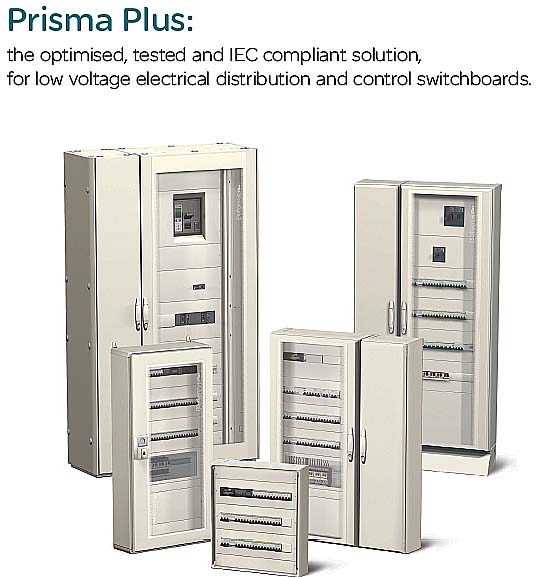
Рис. Schneider Electric
With Prisma Plus G you can be sure to build 100% Schneider Electric switchboards that are safe, optimised:
> All components (switchgear, distribution blocks, prefabricated connections, etc.) are perfectly rated and coordinated to work together;
> All switchboard configurations, even the most demanding ones, have been tested.
You can prove that your switchboard meets the current standards, at any time.
You can be sure to build a reliable electrical installation and give your customers full satisfaction in terms of dependability and safety for people and the installation.
Prisma Plus G with its discreet design, blends harmoniously into all tertiary and industrial buildings, including in entrance halls and passageways.
With Prisma Plus G you can build just the right switchboard for your customer, sized precisely to fit costs and needs.
With this complete, prefabricated and tested system, it's easy to upgrade your installation and still maintain the performance levels.
> The wall-mounted and floor-standing enclosures combine easily with switchboards already in service.
> Devices can be replaced or added at any time.
[Schneider Electric]С помощью оболочек Prisma Plus G можно создавать безопасные распределительные щиты, на 100 % состоящие из изделий Schneider Electric:
> все изделия (коммутационная аппаратура, распределительные блоки, готовые заводские соединения и т. д.) полностью совместимы механически и электрически;
> все варианты компоновки распределительных щитов, в том числе для наиболее ответственных применений, прошли испытания.В любое время вы можете доказать, что ваши распределительные щиты полностью соответствуют требованиям действующих стандартов.
Вы можете быть полностью уверены в том, что создаете надежные электроустановки, удовлетворяющие всем требованиям безопасности для людей и оборудования
Благодаря строгому дизайну, распределительные щиты Prisma Plus G гармонично сочетаются с интерьером любого общественного или промышленного здания. Они хорошо смотрятся и в вестибюле, и в коридоре.
Применяя оболочки Prisma Plus G можно создавать распределительные щиты, точно соответствующие требованиям заказчика как с точки зрения технических характеристик, так и стоимости.
С помощью данной испытанной системы, содержащей все необходимые компоненты заводского изготовления можно легко модернизировать существующую электроустановку и поддерживать её уровни производительности.> Навесные и напольные оболочки можно легко присоединить к уже эксплуатируемым распределительным щитам.
> Аппаратуру можно заменять или добавлять в любое время.
[Перевод Интент]The switchboard, central to the electrical installation.
Both the point of arrival of energy and a device for distribution to the site applications, the LV switchboard is the intelligence of the system, central to the electrical installation.
[Schneider Electric]Распределительный щит – «сердце» электроустановки.
Низковольтное комплектное устройство распределения является «сердцем» электроустановки, поскольку именно оно принимает электроэнергию из сети и распределяет её по территориально распределенным нагрузкам.
[Перевод Интент]Тематики
- НКУ (шкафы, пульты,...)
- электроснабжение в целом
EN
- branch distribution panel
- distributing board
- distributing panel
- distributing switchboard
- distribution bench
- distribution board
- distribution panel
- distribution switchboard
- gear
- keyboard
- PNL
- SB
- sw & d
- switchboard
- switchboard panel
DE
- elektrischer Verteiler, m
- Schalttafel
- Verteiler, m
FR
- tableau de distribution
- tableau de répartition, m
Англо-русский словарь нормативно-технической терминологии > gear
-
9 Clark, Edward
SUBJECT AREA: Domestic appliances and interiors[br]fl. 1850s New York State, USA[br]American co-developer of mass-production techniques at the Singer sewing machine factory.[br]Born in upstate New York, where his father was a small manufacturer, Edward Clark attended college at Williams and graduated in 1831. He became a lawyer in New York City and from then on lived either in the city or on his rural estate near Cooperstown in upstate New York. After a series of share manipulations, Clark acquired a one-third interest in Isaac M. Singer's company. They soon bought out one of Singer's earlier partners, G.B.Zeiber, and in 1851, under the name of I.M.Singer \& Co., they set up a permanent sewing machine business with headquarters in New York.The success of their firm initially rested on marketing. Clark introduced door-to-door sales-people and hire-purchase for their sewing machines in 1856 ($50 cash down, or $100 with a cash payment of $5 and $3 a month thereafter). He also trained women to demonstrate to potential customers the capabilities of the Singer sewing machine. At first their sewing machines continued to be made in the traditional way, with the parts fitted together by skilled workers through hand filing and shaping so that the parts would fit only onto one machine. This resembled European practice rather than the American system of manufacture that had been pioneered in the armouries in that country. In 1856 Singer brought out their first machine intended exclusively for home use, and at the same time manufacturing capacity was improved. Through increased sales, a new factory was built in 1858–9 on Mott Street, New York, but it soon became inadequate to meet demand.In 1863 the Singer company was incorporated as the Singer Manufacturing Co. and began to modernize its production methods with special jigs and fixtures to help ensure uniformity. More and more specialized machinery was built for making the parts. By 1880 the factory, then at Elizabethport, New Jersey, was jammed with automatic and semi-automatic machine tools. In 1882 the factory was producing sewing machines with fully interchangeable parts that did not require hand fitting in assembly. Production rose from 810 machines in 1853 to half a million in 1880. A new family model was introduced in 1881. Clark had succeeded Singer, who died in 1875, as President of the company, but he retired in 1882 after he had seen through the change to mass production.[br]Further ReadingNational Cyclopaedia of American Biography.D.A.Hounshell, 1984, From the American System to Mass Production, 1800–1932. The Development of Manufacturing Technology in the United States, Baltimore (a thorough account of Clark's role in the development of Singer's factories).F.B.Jewell, 1975, Veteran Sewing Machines. A Collector's Guide, Newton Abbot.RLH -
10 Singer, Isaac Merritt
[br]b. 27 October 1811 Pittstown, New York, USAd. 23 July 1875 Torquay, Devonshire, England[br]American inventor of a sewing machine, and pioneer of mass production.[br]The son of a millwright, Singer was employed as an unskilled labourer at the age of 12, but later gained wide experience as a travelling machinist. He also found employment as an actor. On 16 May 1839, while living at Lockport, Illinois, he obtained his first patent for a rock-drilling machine, but he soon squandered the money he made. Then in 1849, while at Pittsburgh, he secured a patent for a wood-and metal-carving machine that he had begun five years previously; however, a boiler explosion in the factory destroyed his machine and left him penniless.Near the end of 1850 Singer was engaged to redesign the Lerow \& Blodgett sewing machine at the Boston shop of Orson C.Phelps, where the machine was being repaired. He built an improved version in eleven days that was sufficiently different for him to patent on 12 August 1851. He formed a partnership with Phelps and G.B. Zieber and they began to market the invention. Singer soon purchased Phelps's interest, although Phelps continued to manufacture the machines. Then Edward Clark acquired a one-third interest and with Singer bought out Zieber. These two, with dark's flair for promotion and marketing, began to create a company which eventually would become the largest manufacturer of sewing machines exported worldwide, with subsidiary factories in England.However, first Singer had to defend his patent, which was challenged by an earlier Boston inventor, Elias Howe. Although after a long lawsuit Singer had to pay royalties, it was the Singer machine which eventually captured the market because it could do continuous stitching. In 1856 the Great Sewing Machine Combination, the first important pooling arrangement in American history, was formed to share the various patents so that machines could be built without infringements and manufacture could be expanded without fear of litigation. Singer contributed his monopoly on the needle-bar cam with his 1851 patent. He secured twenty additional patents, so that his original straight-needle vertical design for lock-stitching eventually included such refinements as a continuous wheel-feed, yielding presser-foot, and improved cam for moving the needle-bar. A new model, introduced in 1856, was the first to be intended solely for use in the home.Initially Phelps made all the machines for Singer. Then a works was established in New York where the parts were assembled by skilled workers through filing and fitting. Each machine was therefore a "one-off" but Singer machines were always advertised as the best on the market and sold at correspondingly high prices. Gradually, more specialized machine tools were acquired, but it was not until long after Singer had retired to Europe in 1863 that Clark made the change to mass production. Sales of machines numbered 810 in 1853 and 21,000 ten years later.[br]Bibliography12 August 1851, US patent no. 8,294 (sewing machine)Further ReadingBiographies and obituaries have appeared in Appleton's Cyclopedia of America, Vol. V; Dictionary of American Biography, Vol XVII; New York Times 25 July 1875; Scientific American (1875) 33; and National Cyclopaedia of American Biography.D.A.Hounshell, 1984, From the American System to Mass Production 1800–1932. TheDevelopment of Manufacturing Technology in the United States, Baltimore (provides a thorough account of the development of the Singer sewing machine, the competition it faced from other manufacturers and production methods).RLH
См. также в других словарях:
appliances — n. pl. 1. Means, expedients, instrumentalities, resources, steps, measures, ways and means. 2. Appointments, appurtenances, attachments, adjuncts, tools, instruments, appendages, equipments … New dictionary of synonyms
Business and Industry Review — ▪ 1999 Introduction Overview Annual Average Rates of Growth of Manufacturing Output, 1980 97, Table Pattern of Output, 1994 97, Table Index Numbers of Production, Employment, and Productivity in Manufacturing Industries, Table (For Annual… … Universalium
Country Fire Service appliances — CFS appliances Country Fire Service appliances used by the CFS (or SACFS) in the state of South Australia are provided and funded by the South Australian Government, and by donations from the public. As the funding model of government funding is… … Wikipedia
Policy appliances — are technical control and logging mechanisms to enforce or reconcile policy rules (information use rules) and to ensure accountability in information systems. [The use of policy appliances in this context was first described in K. A. Taipale,… … Wikipedia
Copper wire and cable — Copper has been used in electric wiring since the invention of the electromagnet and the telegraph in the 1820s.[1][2] The invention of the telephone in 1876 proved to be another early boon for copper wire.[3] Today, despite competition from… … Wikipedia
Cornwall Fire and Rescue Service — (CFRS) Cornwall Fire and Rescue Service (CFRS) area Coverage Area Cornwall Siz … Wikipedia
Sears, Roebuck and Company — Infobox Company company name=Sears, Roebuck and Co. company logo= company type=Subsidiary of Sears Holdings Corporation foundation=1886 in Chicago, Illinois location=Hoffman Estates, Illinois slogan=Where it Begins. revenue=$23.6 Billion industry … Wikipedia
Framework Programmes for Research and Technological Development — The Framework Programmes for Research and Technological Development, also called Framework Programmes or abbreviated FP1 through FP8, are funding programmes created by the European Union in order to support and encourage research in the European… … Wikipedia
Sears, Roebuck and Company — (also Sears, Sears and Roebuck) any of a very large group of US department stores selling a wide range of products for the family. The company was begun in 1886 in Minneapolis by Richard Sears. He was then joined by Alvah Roebuck when he moved… … Universalium
Technology and society — or technology and culture refers to cyclical co dependence, co influence, co production of technology and society upon the other (technology upon culture, and vice versa). This synergistic relationship occurred from the dawn of humankind, with… … Wikipedia
Sears, Roebuck and Co. — Richard Sears, a railroad station agent, sold (for a profit) a local jeweler s unwanted shipment of watches in North Redwood, a rural area of Minnesota, and thus began a small watch business. After moving to Chicago, Sears met Alvah C. Roebuck … Historical Dictionary of the Fashion Industry
